Separations & Membrane Technologies

Our research explores how differences in molecular size, chemical affinity, and transport behavior can be used to separate valuable components from complex mixtures. We connect these fundamental questions with the engineering of membranes and sorbents for desalination, chemical purification, and critical mineral recovery. One focus is the development and evaluation of membrane materials, including laser-induced graphene and polymer composites, to understand how their structure and surface properties influence permeability, selectivity, and stability. We are particularly interested in how membrane chemistry, pore structure, and interactions between dissolved species and material surfaces determine separation performance in complex mixtures. Our desalination research encompasses thermally driven membrane distillation and pressure-driven processes, including ultrafiltration, nanofiltration, and reverse osmosis, with particular attention to the challenges posed by highly saline produced water. We examine how feed composition and operating conditions influence transport, mineral scaling, fouling, and membrane wetting, using these insights to guide material selection and process design. Complementing this work, we investigate selective sorbents and functionalized membranes for recovering valuable species, including lithium and rare earth elements. Here, a central challenge is to achieve selective capture in the presence of competing ions while enabling effective regeneration and repeated use. By integrating materials development, experimental characterization, and process modeling, we seek to establish how improvements at the molecular scale can translate into more efficient and durable separation systems.
Reaction Engineering and Catalysis


Our reaction engineering research explores heterogeneous catalysis, and selective absorbent-based separations to advance decentralized, decarbonized production of chemicals and fuels. We investigate ammonia synthesis, separation, and storage, alongside absorption-enhanced methanol synthesis, through high-temperature and high-pressure experiments, materials characterization, cyclic breakthrough testing, and techno-economic analysis. Our ammonia research combines lower-pressure catalytic synthesis with supported and binder-based absorbents, examining how impregnation chemistry and porous-support structure influence working capacity, regeneration, and long-term stability. We have scaled laboratory studies to a pilot-scale system integrating an ammonia synthesis reactor, absorber, and cracking reactor in a thermochemical loop designed to harness heat from exothermic ammonia synthesis for electricity generation and solar energy to drive endothermic ammonia cracking. For absorption-enhanced methanol production, we couple catalytic reactors with absorbers for rapid, selective removal of methanol and water to overcome equilibrium limitations and mitigate water inhibition, while evaluating how operating conditions affect productivity. We also investigate process electrification through microwave and Joule heating to facilitate renewable electricity integration. These platforms connect materials chemistry with integrated reaction-absorption processes for sustainable chemical manufacturing.
Process Engineering, Energetics & Thermodynamics

Our group investigates how thermodynamic behavior and the transport of heat and mass govern the performance of chemical processes. As engineers, we translate these fundamental insights into practical strategies for improving efficiency and recovering valuable resources. We combine molecular thermodynamics, process simulation, and experimental investigation to predict phase behavior, understand mineral scaling, and evaluate alternative process configurations. Particular interests include heat recovery in membrane distillation, integrated reaction–separation systems, and ammonia-based thermochemical energy storage. Through energy and exergy analyses, we examine how energy is consumed and how irreversibility limits its useful conversion, while optimization and technoeconomic assessment guide equipment design and operating conditions. This framework also supports resource valorization: recovering water and valuable materials from complex industrial streams while evaluating the energy requirements and economic feasibility of their recovery.
Electrified and Advanced heating
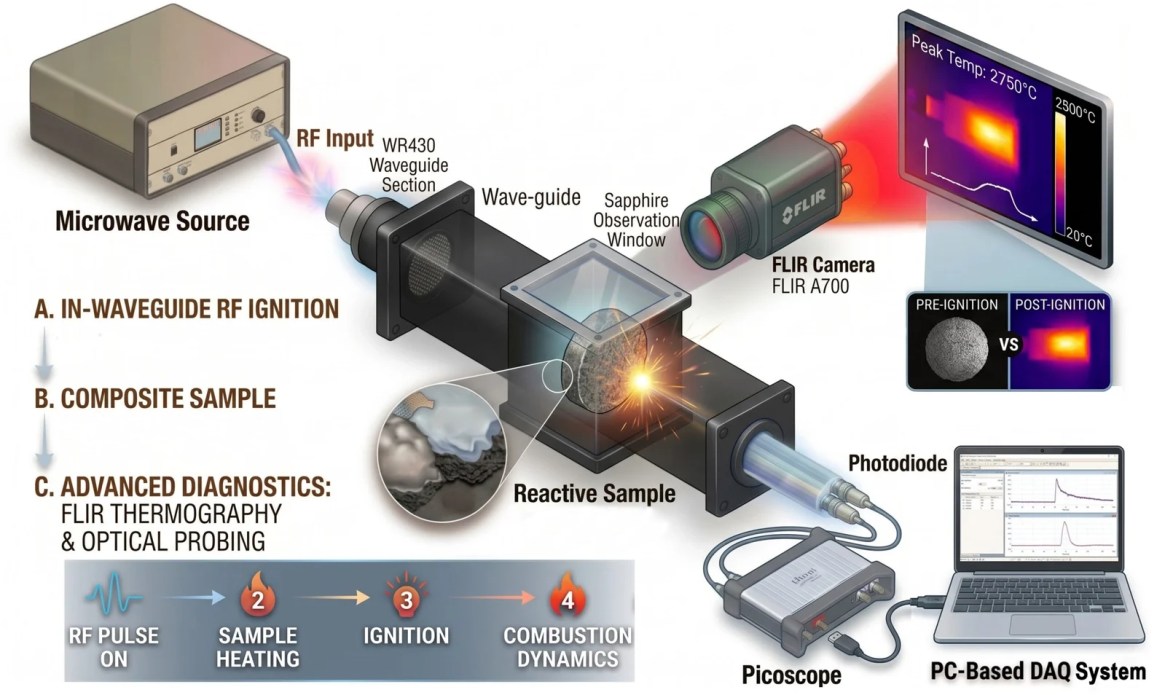
Electromagnetic heating offers a precise, non-contact route for initiating energetic materials, but many reactive formulations suffer from low intrinsic dielectric loss and high microwave transparency. Integrating Graphene overcomes this limitation by serving as an ultra-efficient electromagnetic receptor. Due to its porous, 3D conductive network, tunable defect density, and tailored geometric patterning, LIG exhibits exceptionally high microwave absorption and strong local electric-field localization. When irradiated with microwave energy, the graphene layer rapidly couples with the electromagnetic field, converting microwave radiation into intense localized thermal energy via dielectric and ohmic dissipation. This focused, instantaneous energy deposition drastically bypasses conventional thermal conduction lag, creating sharp thermal gradients that accelerate pre-ignition chemical kinetics and significantly reduce ignition delay.